Pawna Lake today is where Alibaug was 15 years ago and the rate of development within second home markets across the country have dramatically increased post covid. This translates into a reduced timeline for steep appreciation to kick in. I see the same trend unfolding again and I am betting on it. As a bespoke and boutique home developer I see this as the perfect spot for my clients who want to be truly connected to nature and own a home that represents who they are.
The first question people usually ask, where is Pawna Lake? About 110km from Mumbai, 60km from Pune, and 20km from Lonavala, in the Mawal taluka of Pune district. It sits in what I’m calling Mumbai’s “Lake District” the stretch from Thokarwadi Lake to Mulshi Lake, nestled in the Sahyadri foothills, part of the Western Ghats.
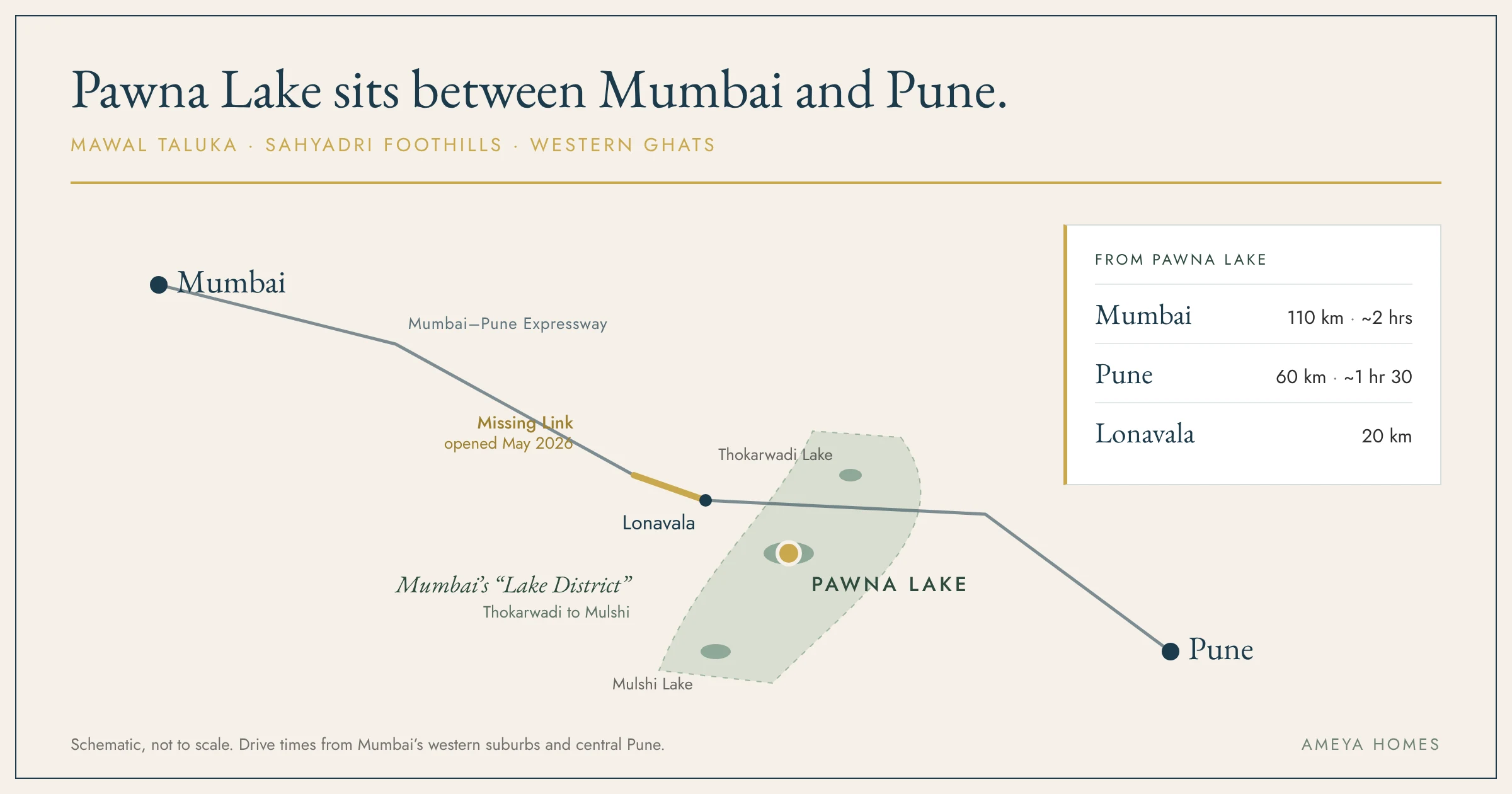
Pawna is sandwiched between Mumbai and Pune. The new Missing Link project has cut door-to-door travel time from Mumbai’s western suburbs to Pawna to around 2 hours; from central Pune, it’s about 1 hour 30 minutes. For Mumbai buyers, that’s a rare trifecta: under 3 hours’ drive, unmatched scenic beauty, and a dramatic shift in weather.
The honest question is why Pawna hasn’t seen large-scale development yet, especially with Lonavala next door running an active second-home market for 50-plus years. The answer is regulatory, not oversight: current zoning permits homes only on plots of an acre or larger, with very low FAR. That’s a real constraint, not an opportunity nobody noticed and it’s the same kind of constraint that shaped Alibaug, where a zoning change roughly a decade ago opened the door to single-family homes on half-acre-plus plots and triggered a wave of small, boutique developers. Pawna hasn’t had that shift yet. My own read is that it’s closer than most people think. What we’ve done instead is work within the constraint as it stands combining two acres to build at a scale we believe buyers will genuinely appreciate: private, spacious, low-density by design, not a workaround waiting for the rules to change. Our first completed villa, in Tikona village, is proof of that.
A little background, so you can understand my biases. I’ve watched development and growth across Alibaug specifically the stretch between Mandwa and Chondi villages firsthand, over the last 35 odd years. My father bought his first piece of land in Awas village for ₹2 lakh in 1991-92 (he overpaid!), and we built our first home there. It was eventually sold, several years later, to a technology entrepreneur who from what I understand still owns it and has kept it as is.
The people who moved to Alibaug pre Covid are the ones who made it what it is today. They were contrarian in their approach.
Why tell you this? Because long before the post Covid boom of 2020-21, a group of people not just Mumbai’s rich list, but artists, free thinkers, freelancers, people connected to nature looking for a place that was truly their own bought and built homes in Alibaug. Infrastructure improved gradually, with the biggest shifts coming from the all-weather RO-RO service in 2020 and now the Rewas-Karanja bridge under construction. My point: the people who moved to Alibaug pre Covid are the ones who made it what it is today. They were contrarian in their approach. Pawna is at that same early stage today: unclaimed, waiting for the right kind of buyer to show up first.
If you want to explore Pawna buying land, buying a villa, or building alongside us I’d like to hear from you directly. And if you’re just curious, follow along: there’s a lot more coming on the location, the villas, and how we’re thinking about the next ten years.
This is a personal view, first published on LinkedIn on 27 July 2026. Travel times are approximate.