This note sets out how I classify land around Pawna, the factors that set its price, and what twelve months of registered transactions show. The examples are from Pawna, but the principles hold for most land.
Two kinds of land
Raw land has poor or no access and little or no infrastructure. It needs further time and capital before it can be developed or sold on.
Developed land is the opposite: access and infrastructure have already been resolved.
What sets the price
Four factors: access, infrastructure, views and location.
Access. This is the most straightforward factor, and the one I would weigh most heavily. A plot with clean legal access along a demarcated concrete or tar road commands a far higher price than one reached by an undefined mud or gravel track. Good access means more than a road surface. The road must be of legal width and sanctioned by the relevant planning authority. It protects value today and when you come to sell.
Infrastructure. A plot with three things in place commands a higher price than one without them: a connected water source, a connected electricity supply and a properly defined boundary. In rural locations each of these can be slow and complicated to solve. Electricity is the clearest example. A new connection usually needs new poles, and those poles often have to stand on, or carry wires across, private land. Owners rarely welcome wires along or across their property, least of all where views and open space are the reason they bought. Expect resistance.
Views. At Pawna, views can separate the price of two adjacent plots. Flat farmland, land overlooking hills and valleys, and land overlooking the lake as well as the hills will each be priced very differently, even when they sit within a few hundred metres of one another.
Location. I include this because Pawna is unusual. Being in a particular village carries little or no price advantage. What counts are the three factors above. A plot that is a 15 to 20 minute longer drive, but has an outstanding view and everything else in order, will command a higher price simply because such plots are scarce.
Twelve months of registered transactions
The figures below are drawn from registrations at three Sub-Registrar offices (Lonavala, Talegaon and Vadgaon) for the 26 villages around Pawna Lake, covering June 2025 to May 2026.
Where land changed hands
The five most active villages by number of transactions:
| Village | Transactions | Share of acreage |
|---|---|---|
| Tikona | 46 | 14.5% |
| Malvandi Thule | 43 | 7.8% |
| Morave | 41 | 10.1% |
| Chavsar | 31 | 6.2% |
| Lohagad | 26 | 4.8% |
| Top five combined | 187 | 43.4% |
These five villages account for 41% of all transactions and 43% of the land transacted.
Deal size
| Parcel size | Transactions | Share of acreage |
|---|---|---|
| Up to a quarter acre (under 11,000 sq ft) | 52 | 1.1% |
| A quarter acre to one acre | 241 | 26.1% |
| More than one acre | 165 | 72.8% |
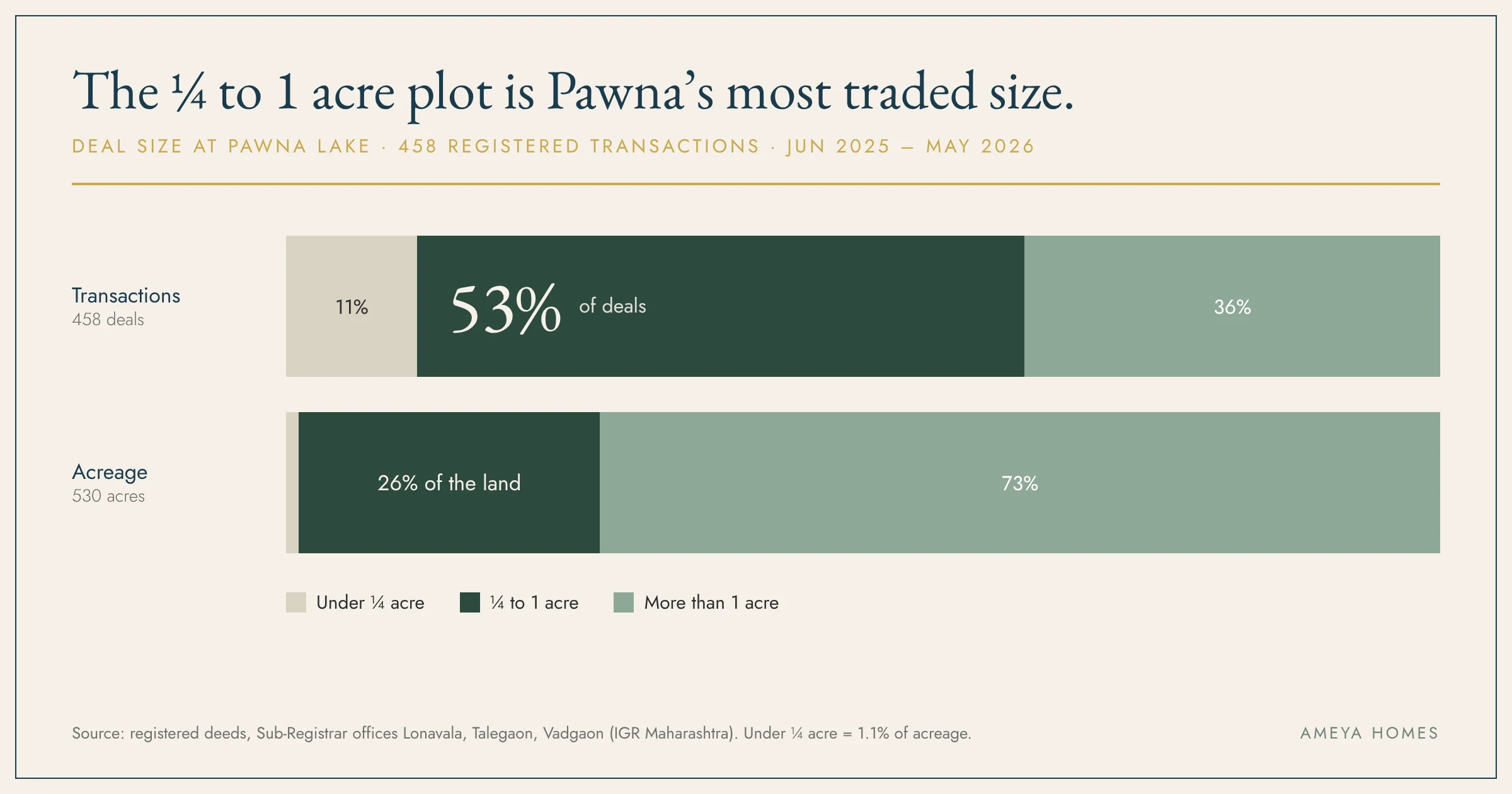
Most transactions are under an acre, but most land changes hands in larger parcels. Deals above one acre are 36% of transactions and 73% of the acreage.
What land is asking today
These are asking prices drawn from online and broker listings and from project representatives. They are not registered transaction values.
Current projects in and around Pawna
- A plotted villa project at Pawna. Plots of 0.5 acre at ₹2.5 to 3 Cr; one acre plots at ₹5 to 6 Cr; villas at ₹8 to 14 Cr.
- A plotted project on Aamby Valley Road. One acre plots at ₹7.5 Cr; villas at ₹18 Cr.
- A lakeside row-house project at Pawna. Row houses at ₹2.75 Cr.
- A villa project at Pawna. Villas on 15,000 sq ft plots at ₹8.95 to 18 Cr.
- A villa project at Mulshi. One acre plots near the project at ₹5.6 Cr; villas at ₹10 Cr.
Asking prices as quoted by project representatives.
The pattern
Across 26 villages the lesson is consistent. Buyers pay for access that is legal and lasting, for infrastructure that is already connected, and for a view. A plot with all three is scarce, and it is that scarcity, not the name of the village, that sets its price.
Source: registered deeds, Sub-Registrar offices at Lonavala, Talegaon and Vadgaon (IGR Maharashtra), June 2025 to May 2026.